 Réseaux & Télécom
(5)
Réseaux & Télécom
(5)
 Système d’information
(12)
Système d’information
(12)
 Poste de travail
(13)
Poste de travail
(13)
 EMAIL
(7)
EMAIL
(7)
 Communication
(4)
Communication
(4)
 Documentation
(1)
Documentation
(1)

 Outils collaboratifs
(12)
Outils collaboratifs
(12)
 Conférence à distance
(5)
Conférence à distance
(5)
 Organisation SI
(25)
Organisation SI
(25)
 Sécurité des systèmes d’information
(4)
Sécurité des systèmes d’information
(4)
 Informatique scientifique
(1)
Informatique scientifique
(1)
 Innov’Space
 Calcul haute performance
(16)
Calcul haute performance
(16)
 Digital Learning
(10)
Digital Learning
(10)
 Logiciels en licence éducation
(5)
Logiciels en licence éducation
(5)
 Locaux numériques
(6)
Locaux numériques
(6)
 Gestion administrative
(9)
Gestion administrative
(9)
 Ressources humaines
(5)
Ressources humaines
(5)
 Scolarité
(2)
Scolarité
(2)

 UNE CHAMBRE À BROUILLARD POUR VOIR L’INVISIBLE
Publié le mercredi 27 janvier 2021
Dernière modification le 6 septembre 2021.
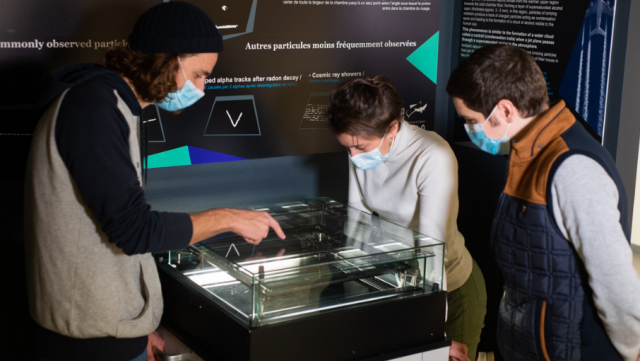
Installée depuis la rentrée de 2020, une chambre à brouillard ou cloud chamber, rend visible les radiations cosmiques et terrestres. Un équipement situé au premier étage du Département Electronique, Optronique et Signal (DEOS), destiné aux étudiants pour étudier l’environnement radiatif naturel ayant une incidence sur le développement des systèmes électroniques aérospatiaux embarqués.
La radioactivité naturelle ambiante comprend de nombreuses particules ionisantes différentes. Ces particules sont très petites et se déplacent à grande vitesse, ce qui les rend invisibles à l’œil nu. Elles se distinguent les unes des autres par la forme de leurs traces dans la chambre à nuage.
Le principe de cette chambre repose sur le maintien d’une couche de vapeur d’alcool sursaturée sur une plaque refroidie à -30°C. Dans cette région, les particules chargées produisent une trace de points de condensation conduisant à la formation d’un nuage d’alcool visible à l’œil nu. Ce phénomène est similaire à la formation d’un nuage d’eau appelé traînée de condensation lorsqu’un avion à réaction traverse une région sursaturée de l’atmosphère.
DES OUTILS POUR LA FORMATION ET LA RECHERCHE
Cet équipement, acquit dans la cadre de la Chaire Nuclétudes, permet de sensibiliser les étudiants de l’ISAE-SUPAERO aux effets des environnements radiatifs (neutrons atmosphériques, rayons cosmiques, ceinture de radiations, éruptions solaires, …) sur les systèmes embarqués, qu’il s’agisse de systèmes spatiaux, de lanceurs, de systèmes avioniques, de centres de calcul ou de l’électronique embarquée dans les automobiles.
La miniaturisation et le perfectionnement des puces électroniques impliquent une sensibilité grandissante à l’environnement radiatif naturel. Aujourd’hui, considérer les risques liés aux radiations dans le développement des systèmes électroniques de pointe devient une nécessité. En ce sens, l’ISAE-SUPAERO s’intéresse aux effets des particules ionisantes sur les composants et systèmes électroniques. L’Institut réfléchit ainsi aux techniques et aux méthodes à mettre en œuvre lors de la conception ou de l’opération des systèmes électroniques critiques pour les prémunir contre tout dysfonctionnement.
Pour contrer l’impact de l’environnement radiatif naturel sur la conception des systèmes, l’ISAE-SUPAERO et NUCLETUDES ont signé une chaire pour mettre en valeur, auprès des étudiants de l’Institut, le rôle majeur de l’électronique dans les systèmes aéronautiques et spatiaux modernes qui nécessitent de mettre en place les solutions de protection essentielles à la robustesse de ces systèmes pendant toute leur durée de vie. Les enseignements liés à cette chaire mettent en évidence la nécessité de prendre en compte, dès la phase de conception, les perturbations induites par ces radiations sur les systèmes électroniques embarqués pour en garantir la robustesse.
MATÉRIALISATION DES RADIATIONS NATURELLES GRÂCE À LA CLOUD CHAMBER
Sur le même sujet
-
Recherche volontaires pour participer à une expérience avec l’équipe Facteurs Humains du DCAS !
11 mars 2022 - Info recherche, Communication interne, Recherche -
La thèse de Pablo Caron en 180 secondes : lauréat d’un prix de thèse 2020 Fondation ISAE-SUPAERO
19 janvier 2021 - Recherche, Communication -
La thèse de Alexandre Le Roch en 180 secondes : lauréat du prix de thèse 2020 Fondation ISAE-SUPAERO
18 janvier 2021 - Recherche, Communication -
Meritorious Conference Paper Award décerné à Vincent Goiffon
15 décembre 2020 - Recherche -
Appel à candidatures : Echange entre chercheur.es et journalistes
7 décembre 2020 - Recherche, Communication -
Le projet I CARE dans la course pour le concours « les ingénieurs du futur » de l’Usine Nouvelle, à vos votes !
25 novembre 2020 - Formation, Recherche, Communication, Espace -
Soutenance de thèse de Baptiste Chide doctorant DEOS le 01/12/20 à 14h
25 novembre 2020 - Recherche, Espace -
ET SI NOS AMPOULES DEVENAIENT DES ANTENNES ?
13 novembre 2020 - Recherche -
Le projet d’un avion sans pilote, zéro émission pour traverser l’atlantique sud
22 octobre 2020 - Recherche -
DMSM - Journée nationale structures 3AF - jeudi 22 octobre 9h à 17h30
19 octobre 2020 - Colloque, Recherche